Call - 1 (800) 475-9975
Book Now


In a world racing toward automation and smart everything, chauffeur services are cruising straight into a technological renaissance. What used to be the epitome of luxury, a polished car, a professional driver, and a smooth, quiet ride, is now being reimagined through the lens of Artificial Intelligence (AI) and Machine Learning (ML). These technologies aren’t just futuristic concepts anymore; they’re the invisible copilots redefining how we move, travel, and even think about “being driven.”
For decades, luxury car experiences revolved around comfort, elegance, and reliability. But today, sophistication wears a digital face. Passengers expect more than a leather seat and bottled water, they want predictive routes that dodge traffic jams before they happen, cars that remember their favorite temperature settings, and seamless coordination between their calendar, trip, and chauffeur. It’s not just about the ride anymore; it’s about intelligent movement.
Imagine a system that knows when your flight is delayed before you do, adjusts your pickup time automatically, and selects the most scenic route home while conserving energy. That’s not a far-off dream, it’s the direction the industry is already heading. AI is stepping into the driver’s seat of decision-making, handling everything from traffic pattern analysis and safety monitoring to personalized passenger experiences.
As this shift accelerates, we’re witnessing more than an upgrade, it’s the dawn of a new kind of mobility. One where data, design, and intelligence merge to create journeys that are safer, smarter, and surprisingly human. The question isn’t whether AI will change chauffeur services, it’s how fast it will happen, and how far it will take us.
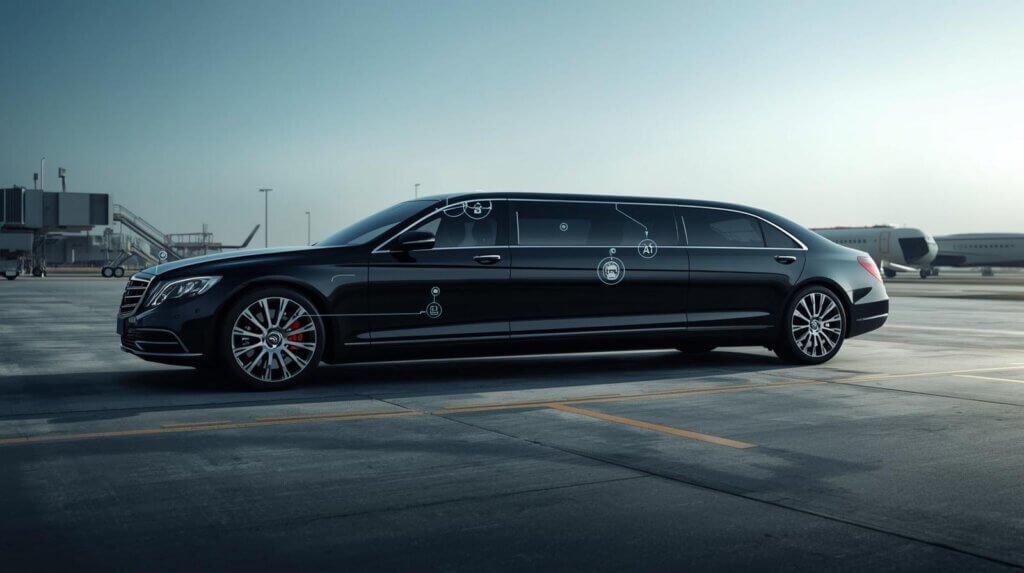
Even before AI, the premium ground transport market, luxury car hire, chauffeur limo services, corporate chauffeur service, and more, stood apart by delivering comfort, privacy, reliability, and convenience. But customers increasingly expect more than just a sleek car and polite driver. They expect:
Traditional chauffeur business models, especially manually operated fleets, struggle to provide all of that at scale and margin. Enter AI & ML, a toolkit that not only enhances operations but can transform the very promise of chauffeured mobility.
Before applying specifically to chauffeur services, let’s look at how AI is already deployed in broader transportation:
These are not distant experiments: these technologies are maturing now, laying the infrastructure that chauffeur services can leverage.
Let’s break down how AI & ML will transform the core facets of a chauffeur enterprise:
Using fleet management predictive maintenance software or ML models, operators can continuously monitor vehicle health. Advanced sensors capture vibration, temperature, engine data, and more. The algorithms process to forecast when parts may fail or need servicing, before breakdowns occur.
This proactive approach reduces downtime, extends vehicle life, and ensures that your chauffeur business runs reliably. According to a research overview, applying ML in vehicles for predictive maintenance can reduce unexpected failures significantly. ResearchGate+2SpringerLink+2
In practice, a fleet manager at Book-N-Ride might receive alerts:
“Vehicle #17’s brake actuator shows trend toward anomaly, schedule inspection in 12 hours”
That kind of insight turns maintenance from reactive to strategic.
Fleet optimization is about matching supply (cars, drivers) with demand (rides), minimizing idle time, and maximizing utilization. AI can dynamically reroute vehicles, reassign drivers, balance coverage across zones, and anticipate demand surges (e.g. near airports, events).
Thus, rather than drivers waiting idle in some zones and lacking presence in others, your system is always adjusting. Real-time optimization ensures the right car is in the right place at the right time.
Safety is nonnegotiable in premium mobility. Here’s where how machine learning improves chauffeur safety becomes more than marketing:
There’s mounting research showing that predictive safety systems reduce crash risk.
In your corporate chauffeur service setting, clients may feel safer knowing that the vehicle and systems actively guard against danger.
One of the strongest differentiators AI brings is chauffeur service personalization. Imagine:
Combined with chatbot customer support, your system can respond instantly to routine requests, freeing human staff for higher value tasks.
Clients no longer accept “He’s on the way.” They want precision: “Your car will arrive in 3 minutes at this exact spot.” That requires real time tracking with AI, ingesting GPS, traffic, weather, and predictive models to continuously compute the optimal arrival time.
From the client’s perspective, that translates into confidence, fewer surprises, and smoother communication.
We must address the big shift: ai in autonomous vehicle technology and self driving car future. While full autonomy across all geographies is still emerging, the direction is clear. Chauffeur fleets will gradually incorporate electric autonomous vehicles, reducing reliance on human drivers and opening new economics.
Early adoption might begin with low-risk zones (airport shuttles, gated communities) or hybrid models (human oversight + autonomous driving). Over time, electric autonomous vehicles may operate full chauffeured services without a human in the driver’s seat.
This shift is powered by advanced machine learning models, sensor fusion, reinforcement learning, and high-precision mapping.
Let’s walk through a hypothetical future chauffeured ride experience:
That level of seamless orchestration was unimaginable a few years ago, but AI & ML make it realistic.
No transformation is without friction. Some of the key challenges:
An ethical, transparent approach (e.g. allowing user override, explaining AI decisions, human fallback) will be critical to adoption.
From a business perspective, AI & ML bring multiple uplift:
| Area | Opportunity | Impact |
| Operational Efficiency | Predictive maintenance, fewer breakdowns | Lower downtime, lower repair cost |
| Utilization | Smarter dispatch, demand forecasting | Improve asset use, reduce idle time |
| Differentiation | Personalization, real-time tracking | Stronger client loyalty, premium pricing |
| Safety & Trust | ML safety monitoring, AI features | Lower risk, higher client confidence |
| Scalability | Automating customer support & optimization | Lower human headcount, scalable growth |
Over time, a well-executed AI stack can shift a chauffeur business from cost center to technology-driven platform.
Q: Will professional chauffeurs be made obsolete by AI?
A: Not in the near term. AI will augment drivers first, helping them make safer decisions, follow optimized routes, and handle workflows. Over time, autonomous vehicles may reduce dependency on human drivers, but the transition will span decades. In fact, human chauffeurs will remain essential for offering personal attention, discretion, and hospitality, qualities AI cannot replicate. The future will likely blend technology and human service, not replace one with the other.
Q: How soon will the self-driving car future be mainstream in luxury services?
A: In controlled environments (airport shuttles, campuses, gated communities), you may see deployments within 5–10 years. Widespread, always-on autonomous rides in all cities may take longer, due to regulation and infrastructure. Luxury brands and chauffeur limo services are already testing early versions of these systems to enhance comfort and safety. However, mainstream adoption will depend on public trust and proven long-term reliability.
Q: Are the costs of integrating AI into a chauffeur business worth it?
A: For scale operators, yes. The efficiency gains, risk reduction, and improved client experience often outweigh upfront investment. Smaller operators can adopt modular AI features gradually. Over time, these upgrades help reduce fuel costs, maintenance expenses, and scheduling inefficiencies. Plus, early adopters gain a clear competitive edge in offering smarter, more connected chauffeur services.
Q: What happens if AI makes a mistake in routing or safety decision?
A: Systems must have human override, logging, fail-safe fallback. Transparency and clear accountability are essential for risk mitigation. Leading companies ensure continuous monitoring and frequent AI audits to prevent errors. As a safeguard, human supervisors or drivers will always remain in the loop to intervene when conditions go beyond AI’s predictive capabilities.
Q: Can existing fleets retrofit AI and ML systems?
A: Yes. Many predictive maintenance modules, telematics, sensor kits, and software platforms support retrofit. The key is integrating data, calibrating models, and managing change. Upgrading existing fleets with smart features like real-time tracking with AI or fleet management predictive maintenance software can be done in stages. This gradual approach helps chauffeur businesses modernize without full replacement, ensuring smoother transitions into the AI-driven future.
AI isn’t just changing how we drive, it’s transforming how vehicles think about maintenance and safety. Predictive systems powered by machine learning can now detect subtle patterns long before a breakdown occurs, from wear in brake systems to shifts in engine performance, allowing fleets to fix problems before they even appear. This proactive approach doesn’t just save time and cost; it redefines reliability across the entire chauffeur and transportation industry.
At the same time, AI is becoming the backbone of future mobility ecosystems. It’s shaping how cities manage traffic, how vehicles communicate with one another, and how travelers experience seamless, connected journeys from start to finish. The same algorithms that predict maintenance issues today will soon help create self-optimizing transport networks, systems that learn, adapt, and evolve with every mile.
The message is clear: the future of mobility won’t just be automated, it’ll be intelligent, predictive, and deeply personal.
The future of chauffeured services will not be a marginal upgrade. It will be a reimagination powered by AI & ML. From fleet optimization, predictive maintenance, safety enhancements, to personalized ride experiences, the transformation will be deep and far reaching as investing early in these capabilities means offering unmatched reliability, anticipating client needs, and staying ahead in a competitive landscape. As autonomous technologies mature and consumer expectations evolve, the boundary between “chauffeur service” and “intelligent mobility platform” will blur, and those who lead will define the next generation of luxury ground transport.
By Book N Ride
Connecticut & New York Airport Limo Service Experts
Dedicated to providing licensed, insured, and verified transportation for travelers who value comfort, safety, and trust.
📌 Also Read: how to start a limo business NYC


My driver was very nice and polite. you can tell he has been a driver for many years.

Logan
Easy pickup, on time even with my late request, emails answered promptly, and all-around highly professional experience. You will hear from me again!
Erik