Call - 1 (800) 475-9975
Book Now


For years, travelers viewed LaGuardia Airport as a symbol of overcrowding and disorganization, a place where curbside traffic could gridlock in minutes and arrival lanes felt more like rush-hour bottlenecks than airport roadways. But entering 2025, the airport is operating under an entirely different blueprint.
The transformation is no longer limited to gleaming concourses or modernized terminals. At LaGuardia Airport, the real shift is unfolding outside the buildings, on the ramps, in staging lots, within the parking garage structures, and across a redesigned traffic network engineered to prevent the meltdowns that once defined peak travel periods. As one piece of evidence, when the Federal Aviation Administration (FAA) warned of rising controller shortages and imposed flow limits at major New York-area airports, explicitly including LaGuardia Airport.
This new operational system arrives amid a turbulent moment: unpredictable weather patterns, nationwide staffing shortages at air-traffic control, government shutdown aftershocks, and a string of high-profile incidents, such as the recent collision of two regional jets at LaGuardia Airport. Those pressures have pushed airport authorities to implement rules that prioritize flow, safety, and predictability, even if it means less curbside convenience.
At its core, the overhaul is about containing chaos and buffering volatile demand. The revised rules at LaGuardia Airport now serve as a model: fewer idling vehicles at curbs, dedicated zones for pickups, structured staging lots, and reinforced enforcement. For travelers, this means the “just pull up and wait” mindset has largely been replaced with “know your zone, know your terminal, and expect the walk.”
What follows is a fact-driven guide to how ground transport at LaGuardia Airport works now, why it changed, and what travelers should realistically expect when navigating the airport in 2025.
One of the most important things to understand about the 2025 rules is that they were not introduced as a “customer experience” improvement. Their primary purpose is operational protection.
For years, officials documented several recurring issues:
On a bad day, the entire front-of-terminal road could freeze, taking down access for buses, shuttles, and even fire and rescue units.
The redesigned layout aims to:
This wasn’t a cosmetic change. It was a structural, safety-driven overhaul.
Terminal B is the most important testing ground for LaGuardia’s pickup reforms. It handles one of the highest daily passenger volumes and therefore faced the most severe congestion issues before redevelopment.
Once passengers retrieve checked bags, they follow blue-and-white signage toward an enclosed pedestrian bridge leading directly into the Terminal B parking garage. Pickups occur on Level 2, divided into clearly marked rows and zones.
Every pickup request, ride-hailing, black car, pre-arranged transfers, is funneled into these structured lanes.
Aviation consultants who studied the redesign note that:
The biggest perk isn’t efficiency, it’s resilience.
When FAA staffing shortages triggered system-wide delays last fall, Terminal B’s garage absorbed hundreds of extra pickups without collapsing into gridlock. Before redevelopment, that same scenario would have shut down all three arrival lanes.
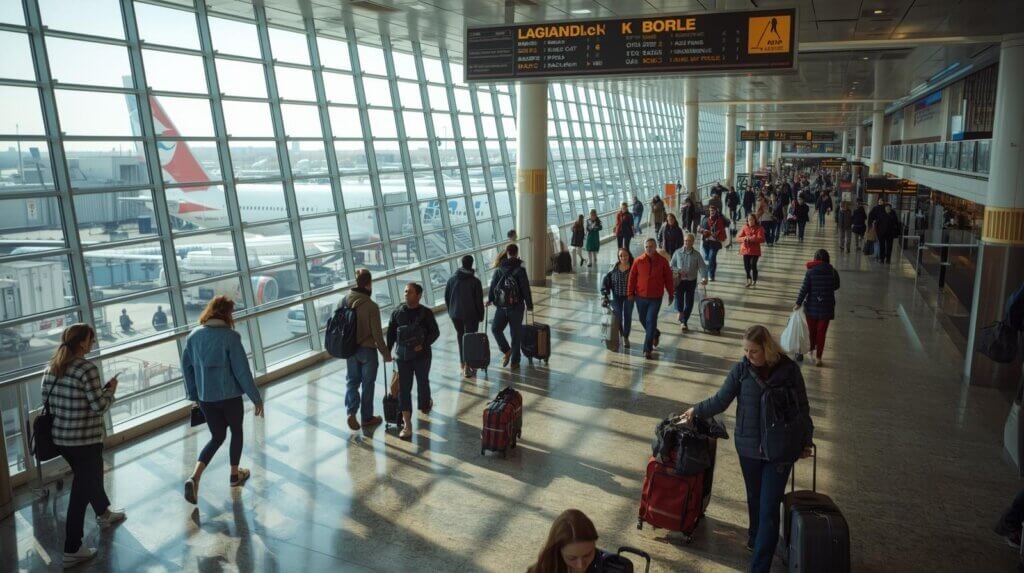
Terminal C is Delta’s primary home, and its volume reflects that status. With multiple concourses feeding into a modern but narrow arrivals area, ground congestion can spike quickly.
Pickups are managed in designated outdoor zones — 10A, 10B, 10C, and related identifiers, which spread out vehicles and avoid the crush of people pouring out of a single exit.
Travelers reach these areas via marked exits and walkways. The signage is consistent, but during peak hours, the crowds can be dense.
Because Delta operates such a large portion of total flights, any upstream delay, weather patterns over the Midwest, ground holds in Boston, congestion over D.C., can cascade into Terminal C.
The taxiway collision between two Delta Connection aircraft in late 2024 showed how fast a local event can create larger operational ripples. Gate swaps, delayed deplaning, and rerouted passengers caused temporary crowding around the terminal’s escalators, which then pushed additional volume into the pickup zones within minutes.
The zone-based system keeps the front curb open for emergency and operational use even when demand spikes dramatically.
Terminal A (Marine Air Terminal) still resembles a legacy airport more than a rebuilt one, and in many ways, that works to its advantage.
While private vehicles are allowed brief curbside access, for-hire pickups are routed to a dedicated lot, ensuring the frontage doesn’t get clogged.
Frequent flyers repeatedly cite Terminal A as the “fastest to get out of,” particularly during holiday periods when other terminals are at capacity.
The evolution of ground transportation rules is tied to events far beyond the curb lanes.
Here are the developments that mattered most.
A Politico investigation published in fall 2025 detailed an alarming rise in controller call-outs across major New York airspace facilities. The FAA acknowledged that reduced staffing could temporarily limit airspace capacity, effectively staggering inbound flights.
Operational impact:
When airspace capacity drops, arrivals bunch up later in the day, creating a “traffic wave” of hundreds of passengers entering arrivals simultaneously. The updated ground system is designed to absorb those spikes.
The NTSB confirmed an inquiry into the taxiway collision involving two Delta regional aircraft at LGA. Though no injuries occurred, the incident triggered temporary traffic halts at ramps and gates.
Operational impact:
Passengers deplaned later than scheduled, and gate changes caused uncertainty across Terminal C. Pickup areas saw a noticeable surge as multiple flights released passengers at once.
The Port Authority’s new regulatory document formalized several rules that had been “temporary” during construction:
Operational impact:
These rules lock in the pickup-zone system as a long-term policy, not a trial.
| Terminal | Primary Pickup Location | How Passengers Get There | Best For | Operational Notes |
|---|---|---|---|---|
| A | FHV lot; curbside OK for private cars | Short walk, minimal signage needed | Travelers wanting fast exit | Least congestion risk |
| B | Garage Level 2 (Row-based) | Indoor walkway from arrivals | High-volume operations | Handles delays better due to internal absorption |
| C | Outdoor zones 10A–10C | Marked exits and outdoor lanes | Delta-heavy travel itineraries | Most sensitive to upstream flight clusters |
The modernization has improved the overall system, but understanding the new rules helps avoid hiccups.
Passengers report:
Terminal B signage receives praise for consistency; Terminal C signage is clear but sometimes overshadowed by crowd density.
Travelers consistently note:
The biggest problem is terminal misidentification. Many visitors assume all pickups operate the same way — they don’t.
The 2025 transportation network at LaGuardia is built around one idea: avoid collapse during peak pressure. Between FAA scheduling turbulence, weather-driven delays, and unexpected operational incidents, New York’s airports operate under constant strain.
The new pickup system, garage-based loading, zone distribution, limited curbside access, is an attempt to keep ground traffic predictable when the skies are not.
Travelers who know the layout will move through the airport far more easily than those who arrive expecting the pre-redevelopment system. For a place once synonymous with chaos, that may be the most meaningful improvement yet.
LaGuardia Airport is closer to Manhattan. It sits roughly eight miles from Midtown, while JFK is about fifteen miles away in southern Queens. Travel time varies with traffic, but LGA usually offers the shorter drive.
It depends on your priorities.
LaGuardia isn’t “small,” but it is more compact than JFK. It handles high passenger volume within a tighter footprint, which is why its roadway and pickup rules are more controlled. The recent redevelopment modernized the facilities while keeping the airport’s overall scale efficient and easy to navigate.
The two airports serve different roles:
Accessibility is another key difference: LaGuardia Airport is closer to Manhattan, whereas JFK offers far greater flight variety but takes longer to reach.
As New York settles into this updated version of the airport, the changes to ground transportation will continue shaping the way travelers move through the city. The redesigned pickup zones, clearer terminal separations, and stricter traffic patterns were not introduced to complicate the experience, but to keep it functional during the moments that historically pushed LaGuardia Airport to its limits. Heavy weather, FAA delays, and unexpected incidents will always test the system, yet the new layout is built to absorb those surges with far more resilience than before. For travelers, knowing the terminal you’re landing in, understanding how each pickup area works, and giving yourself a little extra time can make all the difference. This is a new era for the airport, one that favors structure over improvisation, and the more familiar you are with its rhythm, the smoother your arrival will be.
By Book N Ride
Connecticut & New York Airport Limo Service Experts
Dedicated to providing licensed, insured, and verified transportation for travelers who value comfort, safety, and trust.
📌 Also Read: affordable car service from JFK airport


Driver was fantastic, best driver I have ever had. A pleasure to drive with.

Maria
Your driver got me to the airport in good time and used experience to avoid traffic jams. Thanks for your help.
David