Call - 1 (800) 475-9975
Book Now


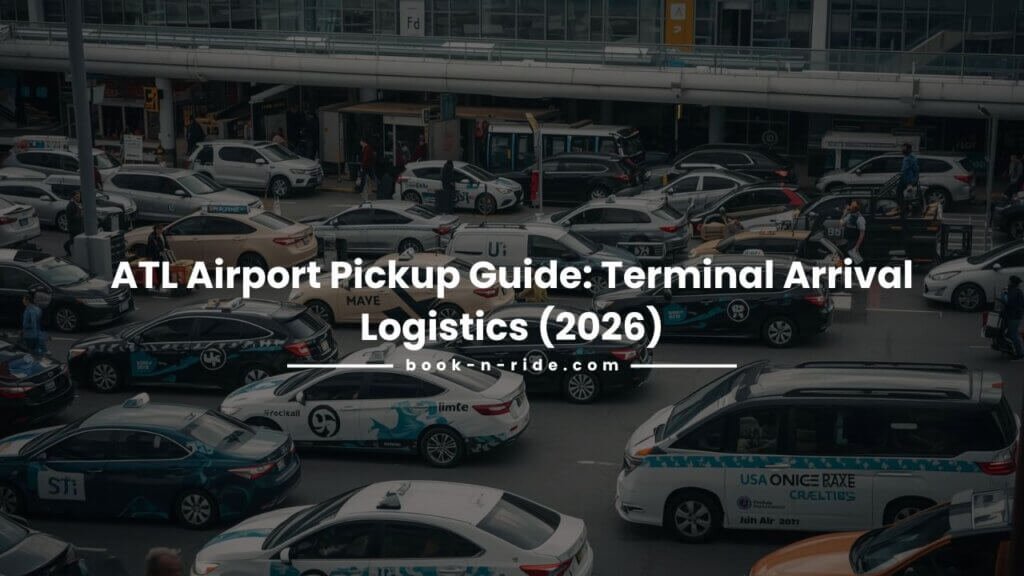
Hartsfield-Jackson Atlanta International Airport (ATL) handles more arriving passengers than any other airport in the United States, but arrival volume alone is not what makes pickup logistics challenging. The real difficulty lies in terminal separation, curbside enforcement, arrival banking patterns, and uneven ground transportation access that change throughout the day.
This guide is written for travelers who need predictable, low-friction airport pickup planning in 2026. It focuses strictly on arrival logistics, not amenities, rankings, or promotional claims. Whether you are coordinating a family pickup, scheduling a business transfer, or managing multiple arrivals across terminals, understanding ATL’s ground transportation flow is essential.
ATL is not a single arrivals curb. It is a distributed arrival system with multiple terminal access roads, separate curbs, and different enforcement patterns depending on terminal and time of day. Domestic arrivals are split between North and South Terminals, while international arrivals are processed through Terminal F, which operates under entirely different timing constraints due to Customs and Border Protection clearance.
In 2026, the airport continues to manage congestion through strict dwell-time enforcement, particularly during peak arrival banks. Vehicles that arrive too early or wait beyond permitted curb times are routinely directed away. Travelers who do not coordinate arrival timing with their pickup location often experience delays even when traffic appears light.
The key difference at ATL is not traffic volume, but arrival synchronization. Flights arrive in concentrated waves, and ground transportation demand spikes accordingly. Planning pickup without accounting for these waves leads to avoidable wait times.
The Domestic North Terminal primarily serves American Airlines, United Airlines, and several other domestic carriers. Arrival traffic here is heavily influenced by afternoon and early evening flight banks. The curbside layout supports commercial vehicles, but enforcement is tighter during peak hours.
Vehicle access routes are more susceptible to bottlenecks because multiple airline arrival banks overlap. Travelers exiting baggage claim may experience curb congestion even when flight arrival counts are moderate.
The Domestic South Terminal handles Delta Air Lines arrivals and operates with a different flow pattern. Delta’s arrival banks are more evenly spaced throughout the day, which results in more predictable curbside turnover, particularly in the late evening.
Ground transportation access is similar in layout to the North Terminal but tends to clear faster outside of peak business travel hours. This difference matters when coordinating pickup across terminals.
International arrivals at Terminal F follow CBP clearance timelines, not airline schedules. Passengers may take anywhere from 30 minutes to over two hours to reach the public arrivals area depending on arrival volume and staffing levels.
Pickup timing here is the most commonly miscalculated at ATL. Vehicles that arrive based on landing time rather than clearance time are frequently forced to circle or exit the terminal roadway.
Curbside pickup is permitted for commercial and private vehicles, but dwell times are closely monitored. During weekday afternoons and early evenings, enforcement officers actively move vehicles that wait without an actively loading passenger.
Pre-arranged pickup works best when scheduled 15 to 25 minutes after baggage claim exit, not landing. Travelers should be prepared to move promptly to the curb upon contact with their driver.
The South Terminal allows similar curbside access, but turnover tends to be smoother outside peak Delta arrival waves. Late evening arrivals often experience faster curb clearance compared to North Terminal.
Drivers typically stage off-site until passenger confirmation is received. This reduces the risk of being directed away during enforcement sweeps.
Terminal F uses designated pickup zones rather than free-flow curb access. Vehicles arriving before passengers clear customs will not be permitted to wait at the curb.
International travelers should not schedule pickup until after clearing CBP and collecting luggage. This terminal requires the most precise coordination between passenger and driver.
Arrival congestion at ATL is driven less by roadway traffic and more by arrival banking, where multiple flights unload passengers into the same pickup zones within compressed time windows. In 2026, these banks remain the primary cause of pickup delays even on days with otherwise normal traffic conditions.
For domestic arrivals, the most disruptive banks consistently occur between 3:30 PM and 7:30 PM local time. During this period, multiple airlines release passengers into Domestic North and South terminals within overlapping 20–30 minute intervals. The resulting congestion is caused by extended curb loading times rather than vehicle shortages, as passengers take longer to reach the curb and organize pickups.
International arrival banks are less predictable but most impactful during late afternoon and early evening, particularly on Fridays and Sundays. When several international flights clear CBP within a short window, passengers reach pickup zones in uneven surges. This creates sudden congestion spikes even when curbside appears clear minutes earlier.
During arrival banks, travelers should expect increased enforcement activity, reduced curb dwell tolerance, and longer coordination time between passenger and vehicle. Planning pickup outside these windows, when possible, significantly improves reliability.
Curbside enforcement at ATL operates on arrival volume forecasting, not visible traffic conditions. In 2026, enforcement intensity increases during known peak arrival windows and during irregular operations such as weather disruptions or runway flow constraints.
Enforcement officers focus on vehicles that arrive before passengers are curb-ready, vehicles waiting without active loading, and unauthorized stopping in restricted or commercial-only zones. These rules are applied unevenly by terminal due to differing arrival patterns.
Domestic Terminal North typically experiences enforcement escalation earlier in the afternoon because of mixed-carrier arrival overlap. Domestic Terminal South enforcement increases later, aligning with Delta’s primary arrival banks. At International Terminal F, enforcement is consistently strict, and vehicles are rarely allowed to pause without the passenger physically present.
Travelers should not assume flexibility during periods of light roadway traffic. Enforcement actions are based on anticipated passenger volume, making precise pickup coordination essential regardless of time of day.
Weather disruptions and irregular operations have a disproportionate effect on ATL arrival pickups because delayed flights often stack arrivals once conditions normalize. This compresses multiple landings into short periods, overwhelming baggage systems, CBP processing, and pickup zones simultaneously.
During these events, baggage delivery times increase, international clearance slows, and pickup zones experience abrupt surges rather than steady flow. Vehicles that arrive based on scheduled landing times are more likely to be redirected, while vehicles arriving late encounter congested curbs with limited loading space.
The most reliable strategy during irregular operations is post-arrival coordination, where pickup is initiated only after the traveler confirms baggage in hand or customs clearance complete. This approach reduces curb conflict and minimizes the risk of vehicle displacement during enforcement sweeps.
In 2026, this remains the most consistent method for maintaining predictable pickup timing at ATL during weather-related or operational disruptions.
ATL separates ground transportation into clearly defined categories, and confusion between them causes delays.
Curbside Pickup
Used primarily by private vehicles and pre-arranged car services. Timing precision is critical due to enforcement.
Rideshare Pickup Areas
Rideshare services operate from designated zones that may require passengers to walk from baggage claim. These zones are subject to demand surges during arrival banks.
Commercial Ground Transportation
Licensed car services and shuttles must follow specific access routes and staging rules that differ by terminal.
Understanding which zone applies to your pickup method is essential for minimizing wait time.
| Terminal | Primary Pickup Location | Average Post-Arrival Wait | Congestion Risk |
| Domestic North | Arrivals Curbside | 15–30 minutes | High (PM peaks) |
| Domestic South | Arrivals Curbside | 10–25 minutes | Medium |
| International F | Designated Pickup Zones | 30–90 minutes | High weekends |
Domestic arrivals at ATL are largely predictable once baggage claim timing is known. International arrivals are not. CBP staffing, flight clustering, and secondary inspections can dramatically extend clearance time.
Weekend afternoons and evenings see the highest international arrival volume. Travelers arriving during these windows should expect longer clearance times and plan pickup accordingly.
Scheduling international pickup based solely on landing time is the most common cause of delays at Terminal F.
One frequent mistake is assuming all domestic arrivals behave the same. North and South Terminals operate differently, and congestion patterns are not interchangeable.
Another common issue is early vehicle arrival. Vehicles that arrive before passengers are ready often lose their place in the pickup flow due to enforcement.
Finally, travelers frequently underestimate walking time from baggage claim to pickup zones, especially at Terminal F.
“At ATL, Domestic Terminal South clears noticeably faster after 8:30 PM because Delta’s main arrival banks taper off, while Domestic North continues handling late-evening arrivals from multiple carriers. For evening pickups, confirming the correct domestic terminal can save 15 minutes or more.”
This timing difference is not published by the airport but is consistently observed in daily operations.
Where should my driver wait at ATL?
Drivers should stage off-site until the passenger confirms they are exiting baggage claim.
Is curbside pickup allowed at all ATL terminals?
Yes, but enforcement and timing rules differ by terminal.
How long after landing should I schedule pickup?
Domestic arrivals: 20–30 minutes. International arrivals: only after CBP clearance.
Are rideshare rules different at Terminal F?
Yes. International arrivals use designated pickup zones, not standard curbs.
What happens if my flight arrives early?
Early arrival does not guarantee early pickup. Baggage and clearance timing still apply.
Can vehicles wait at the curb?
No. Waiting without active loading often results in being directed away.
Effective ATL pickup planning in 2026 is about coordination, not speed. Travelers who align pickup timing with terminal-specific flow experience fewer delays than those who focus only on flight arrival time.
Knowing which terminal you are arriving at, understanding curb enforcement, and accounting for clearance or baggage delays are the factors that matter most. When these elements are managed correctly, ATL pickup becomes predictable even during high-volume periods.
By Book N Ride
Connecticut & New York Airport Limo Service Experts
Dedicated to providing licensed, insured, and verified transportation for travelers who value comfort, safety, and trust.
📌 Also Read: best way from LAX to downtown LA


Easy pickup, on time even with my late request, emails answered promptly, and all-around highly professional experience. You will hear from me again!

Erik
My driver was very nice and polite. you can tell he has been a driver for many years.
Logan