Call - 1 (800) 475-9975
Book Now


For a while, Uber for Business looked like the obvious answer to corporate ground transportation — familiar app, broad coverage, simple expensing. But a growing number of New Jersey companies are quietly moving away from it. Corporate black car accounts NJ businesses are setting up with dedicated providers like Book-N-Ride aren’t just a preference shift — they’re a response to real gaps that show up once rideshare-for-business is put under pressure: surge pricing during exactly the trips that matter most, inconsistent drivers, and support that disappears the moment something goes wrong. What starts as a convenient, low-effort solution for occasional trips often becomes a genuine liability once a company’s travel volume grows.
This guide breaks down why NJ companies are making the switch, what a dedicated corporate black car account actually offers that Uber for Business doesn’t, and what the transition typically looks like.
Uber for Business solved a real problem when it launched — consolidating rideshare receipts under one company profile instead of dozens of individual expense reports. But for companies with regular executive or client transportation needs, several structural limitations tend to surface over time:
None of these issues make Uber for Business a bad product — it simply wasn’t built for the specific demands of consistent executive and client transportation, which is a fundamentally different problem than on-demand consumer rides. That gap is exactly what has pushed more companies toward dedicated corporate black car accounts NJ providers can actually stand behind.
A dedicated corporate transportation account with Book-N-Ride addresses each of these gaps directly, built specifically around the needs of companies rather than individual consumer trips.
Corporate accounts lock in rates ahead of time, so trips are never subject to surge pricing — regardless of time of day, weather, or demand spikes. Budgeting for travel spend becomes predictable rather than a moving target.
Every trip uses a licensed, background-checked professional chauffeur in a clean, well-maintained vehicle — the same standard whether it’s a solo executive trip or a client pickup that reflects directly on the company.
Companies get a direct point of contact who understands their regular routes, preferred vehicle types, and any special instructions — not a generic support ticket routed through an app.
A dedicated fleet with backup vehicles means a mechanical issue or a single driver’s unavailability never becomes the traveler’s problem. That’s especially critical for early morning airport departures, when rideshare cancellation rates spike.
Instead of booking multiple separate rideshare trips for a traveling team, group corporate travel is coordinated as a single reservation, with matched pickup windows and consolidated billing.
Rather than individual receipts flowing through an app-based expense system, all trips consolidate into a single monthly billing corporate account, itemized and ready for accounts payable.
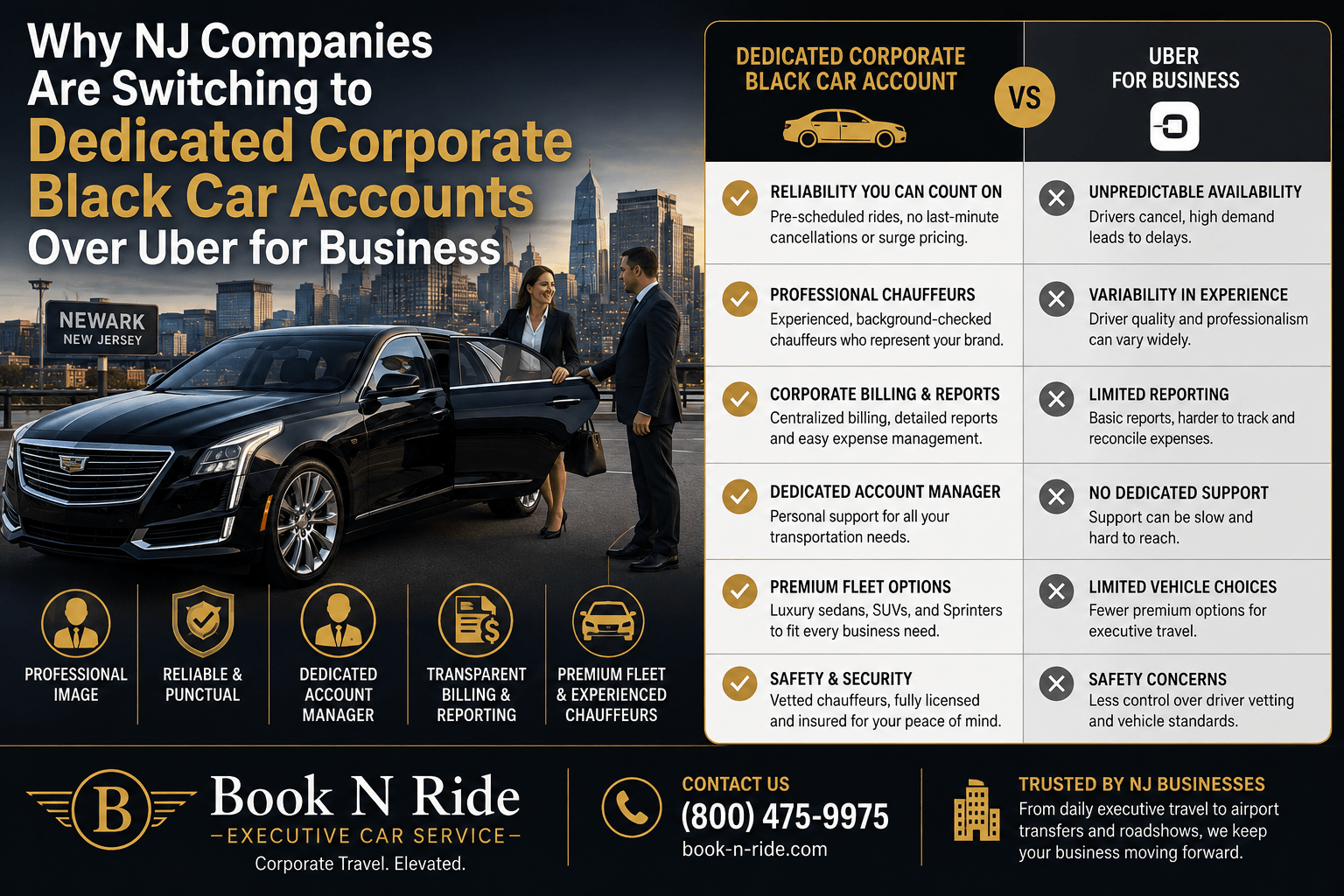
| Factor | Corporate Black Car Account | Uber for Business |
|---|---|---|
| Pricing | Fixed, pre-negotiated | Subject to surge pricing |
| Driver consistency | Licensed, professional chauffeurs | Varies by driver |
| Account support | Dedicated account manager | General app-based support |
| Availability guarantee | Backup fleet available | Driver can cancel anytime |
| Group travel coordination | Single coordinated booking | Multiple separate bookings |
| Billing | Itemized monthly invoice | App-based expense reporting |
A handful of industries with a heavy New Jersey presence are moving fastest toward dedicated corporate transportation, largely because their travel patterns expose Uber for Business’s limitations most acutely:
For companies in these sectors, the cost of a single missed meeting or a client’s poor first impression from an inconsistent rideshare pickup often outweighs any per-trip savings that rideshare might offer.
A few converging factors are driving more New Jersey companies to reconsider their rideshare-for-business setup:
None of these factors are unique to New Jersey, but the state’s dense corporate footprint — particularly in pharmaceuticals, finance, and professional services — means the cumulative cost of unreliable transportation adds up faster than it does for smaller companies with occasional travel needs.
It’s worth being direct about the trade-off companies make by staying with rideshare-for-business past a certain point of travel volume. Every trip booked through a consumer-facing app inherits that app’s underlying limitations, no matter how the billing is structured on the back end. Surge pricing during a snowstorm doesn’t disappear because a corporate profile is attached to the account. A driver who cancels twenty minutes before a 5 a.m. pickup doesn’t behave differently because the ride is being expensed to a company card instead of a personal one.
The corporate features layered on top of rideshare apps — centralized billing, spend reporting, policy controls — solve real administrative problems, but they don’t change the underlying reliability of the ride itself. That distinction is exactly what’s driving more NJ companies to look at dedicated providers instead, once travel volume reaches a point where reliability starts to matter more than convenience.
Companies moving away from Uber for Business typically don’t need to overhaul their entire travel process. Setting up a Book-N-Ride corporate account follows a simple path:
Most companies complete this transition within a single billing cycle, with no long-term contract or complicated software integration required.
Not every company needs to make the switch immediately, and the right timing often depends on a few practical signals rather than a fixed rule. Companies typically find the transition worthwhile once they notice a pattern: repeated surge-pricing complaints from traveling employees, a growing stack of individual receipts that finance is spending real time reconciling, or a specific incident — a missed flight, a late arrival to an important meeting — that made the cost of an unreliable ride suddenly concrete rather than theoretical.
A simple way to test the fit without fully committing is to run a handful of high-priority trips, like executive airport transfers or client pickups, through a corporate account for a month while keeping the existing rideshare setup for lower-stakes trips. Comparing the two side by side, on cost, reliability, and administrative overhead, tends to make the decision straightforward on its own.
Book-N-Ride’s corporate accounts cover business travel to every major airport in the region, including Newark Liberty (EWR), JFK and LaGuardia, and Westchester (HPN), alongside local client pickups and event transportation throughout New Jersey and Fairfield County. A single corporate black car accounts NJ companies set up covers every one of these routes, so there’s no need to compare providers airport by airport.
On a single trip, rideshare can sometimes appear cheaper on paper. But that comparison rarely accounts for the full cost of the alternative: administrative time spent reconciling receipts, the financial impact of a missed meeting or flight tied to a last-minute cancellation, and the reputational cost of an inconsistent experience for visiting clients. Organizations like the Global Business Travel Association have long emphasized that total cost of travel includes far more than the fare on a single receipt, and ground transportation reliability is a growing part of that calculation for corporate travel managers. Once those indirect costs are factored in, a fixed-rate corporate account often comes out ahead, particularly for companies with more than occasional business travel needs.
Beyond cost and convenience, many NJ companies are formalizing ground transportation as part of a broader employee duty-of-care policy. General guidance from the Occupational Safety and Health Administration on employer responsibility for work-related travel underscores why HR and risk management teams increasingly want documented, vetted transportation standards rather than a patchwork of individually booked rideshare trips with no consistent vetting process behind them.
Base pricing is often comparable, but corporate accounts avoid surge pricing entirely and eliminate hidden costs like missed meetings from cancellations, which frequently makes them more cost-effective overall for companies with regular travel needs.
Yes. Many companies test a corporate account for their highest-priority trips, like airport transfers and client pickups, while comparing it directly against their current rideshare experience before fully transitioning.
Most companies are fully set up within a single call, with rates agreed upon upfront and no lengthy contract process required.
Yes. Corporate accounts can be configured to cover employee travel, visiting client and board member pickups, and event transportation, all billed to the same centralized account.
If your company has outgrown what Uber for Business can reliably deliver, corporate black car accounts NJ businesses are switching to offer fixed pricing, professional chauffeurs, and a dedicated account manager — all without the surge pricing, driver inconsistency, and cancellation risk that come with rideshare-for-business. The switch rarely requires overhauling your entire travel process, just replacing the part of it that was never built for this kind of reliability in the first place.
Ready to set up a corporate account for your company? Book online or call (800) 475-9975 to speak with our corporate account team today.


Easy pickup, on time even with my late request, emails answered promptly, and all-around highly professional experience. You will hear from me again!

Erik
Driver was fantastic, best driver I have ever had. A pleasure to drive with.
Maria