Call - 1 (800) 475-9975
Book Now


This article is based on real event-day conditions in East Hartford, not generic stadium assumptions. Traffic patterns around Silver Lane, Route 5, and the stadium access roads change depending on attendance size, weather, and law-enforcement traffic control decisions. The guidance here reflects how transportation actually functions at Pratt & Whitney Stadium during UConn games and large events, using publicly available venue information, Connecticut traffic advisories, and repeat on-the-ground experience planning arrivals and departures in this area. Details are updated for 2026 to reflect current travel behavior and event operations.
If you’ve ever attended a UConn football game or major concert at Pratt & Whitney Stadium, you already know the problem isn’t the drive to East Hartford — it’s the last mile and the exit afterward. That’s where most people lose time, patience, and plans.
The biggest mistake visitors make is assuming this stadium behaves like smaller venues in Connecticut. It doesn’t. Rentschler Field sits in a corridor where Silver Lane, Route 5, and I-84 traffic collide during narrow arrival windows, and once an event ends, thousands of vehicles are released almost at the same moment.
Locals don’t guess their way through it. They plan Pratt & Whitney Stadium transportation around known choke points, predictable traffic control patterns, and Connecticut weather realities — not optimism.
This article isn’t a general overview. It’s a location-specific breakdown of what actually slows people down at this stadium and how experienced attendees avoid the most common problems.
On a map, Pratt & Whitney Stadium looks well positioned. It’s minutes from downtown Hartford, close to major highways, and surrounded by large parking areas. That’s exactly why congestion builds so fast.
Here’s what happens on real event days in East Hartford:
The stadium’s official directions and parking pages explain where to go, but they can’t account for how quickly conditions change once attendance reaches capacity
(Source: Rentschler Field – Directions & Parking).
That gap between “directions” and “reality” is where most delays happen.
According to the Connecticut Department of Transportation, large event venues create short-duration but high-intensity congestion, especially near access roads and exit ramps that were not designed for simultaneous departures
(Source: CTDOT).
At Rentschler Field, this shows up in three predictable ways:
This is why relying on estimated drive times alone consistently fails here.
Yes, the stadium has extensive parking. Official maps clearly show lot layouts and access points
But parking volume and parking efficiency are two different things.
What drivers actually experience:
UConn Athletics confirms that parking operations are scaled for attendance size, but exit times depend heavily on traffic direction policies and crowd movement after events
This is why transportation decisions matter more after the event than before it.
People who attend multiple events each season don’t improvise. They assume:
That mindset is why Pratt & Whitney Stadium transportation is planned the same way locals plan airport runs: early arrival, clear exit strategy, and zero reliance on luck.
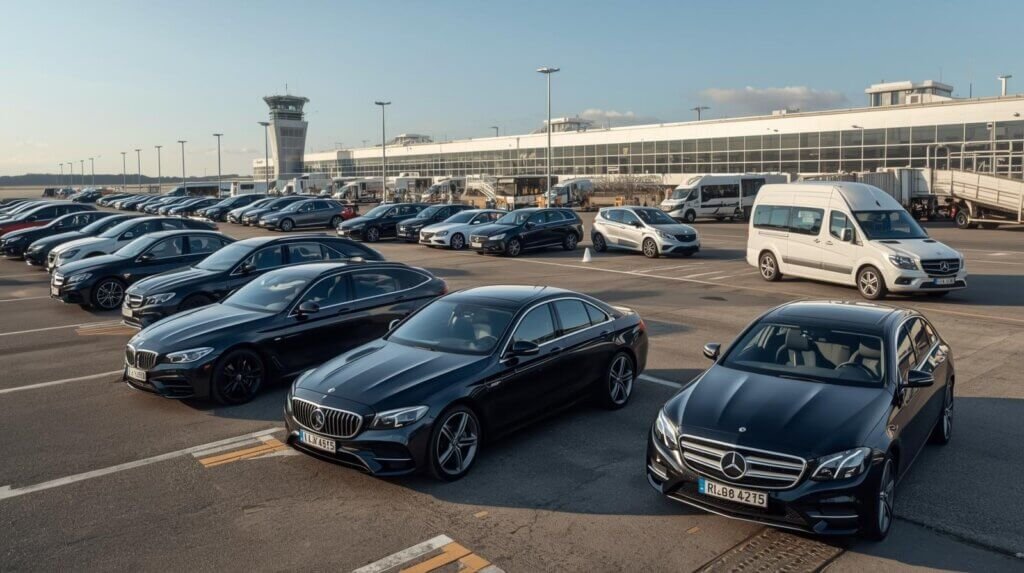
There is no single “best” transportation option for every event. The right choice depends on timing, group size, weather, and tolerance for post-event delays.
| Option | Main Advantage | Common Drawback | Best For |
| Drive & Park | Full control | Slow exits, long walks | Early arrivals |
| Rideshare | No parking | Surge pricing, long waits | Small groups |
| Taxi | Familiar service | Limited post-event availability | Nearby hotels |
| Pre-Booked Car Service | Predictable timing | Requires planning | Busy events |
| Group Transportation | Everyone together | Coordination required | Families, groups |
For large events, predictability matters more than flexibility.
Many attendees misjudge how long it takes to get to the stadium because the drive itself may be short. The real variable is the final approach, parking entry, and walking time.
Local planning guidelines that work consistently:
This approach aligns with guidance regularly shared by UConn Athletics for high-attendance football games, where early arrival is encouraged due to traffic flow and security procedures
Weather plays a larger role in event transportation than many visitors expect. During winter and early spring, even light snow or freezing temperatures can slow:
Connecticut emergency management resources emphasize monitoring winter weather advisories and planning extra travel time during cold-weather conditions
The National Weather Service also notes that winter conditions significantly affect driving behavior and traffic flow
This makes advance transportation planning especially important during colder months.
At Pratt & Whitney Stadium, transportation problems are not random — they are structural. Thousands of people arrive and leave through the same corridors within fixed time windows, under active traffic control. Once the event ends, choices narrow quickly.
Pre-planning Pratt & Whitney Stadium transportation matters here because it allows you to work with known constraints instead of reacting to them.
| Problem | What Happens Without Planning | What Planning Changes |
| Post-event ride demand | Rideshare wait times spike | Pickup time is defined |
| Exit congestion | Vehicles released simultaneously | Departure is staged |
| Traffic redirection | Drivers forced off preferred routes | Route expectations set |
| Weather impact | Delays compound quickly | Buffers already built in |
This is why many regular attendees treat stadium transportation the same way they treat airport ground travel — scheduled, buffered, and confirmed — not improvised at the curb.
Group travel is where small inefficiencies turn into major delays. When groups arrive separately, park in different lots, or leave at different times, the entire exit process slows down.
Organizing Pratt & Whitney Stadium transportation for groups works best when it follows a single-plan approach instead of multiple individual decisions.
| Approach | Typical Result |
| 3 separate cars | 3 different exit times |
| Mixed rideshare + parking | Confusion post-event |
| One coordinated vehicle | Faster regroup + exit |
For families, alumni groups, and corporate outings, this isn’t about comfort — it’s about reducing variables.
Visitors from Hartford, New Haven, Fairfield County, Western MA, or NY often underestimate how localized congestion becomes near Rentschler Field.
The issue is not distance, it’s familiarity with the final approach and exit patterns.
Arranging Pratt & Whitney Stadium transportation ahead of time helps visitors avoid three common problems:
UConn Athletics publishes parking layouts and facility maps to help visitors understand the stadium footprint, but those maps don’t replace experience
For out-of-area visitors, locking transportation earlier consistently produces better outcomes.
These are not general stadium tips — they are patterns observed repeatedly at Rentschler Field.
Traffic control releases vehicles in waves. The initial wave moves slowest.
A short delay (10–20 minutes) often reduces total exit time.
Confusion between “Gate,” “Lot,” and “Road” names is a frequent cause of delays.
Crowded networks drain batteries quickly. Planning ahead avoids communication breakdowns.
These adjustments routinely save more time than changing routes or apps.
Rentschler Field publishes event-specific instructions on its official website
Yes. Connecticut’s Travel Smart system posts real-time alerts, incidents, and closures that directly affect event routes
Demand peaks immediately after events. Wait times and pricing are often unpredictable.
For high-attendance events, 60–90 minutes before start time is a practical local standard.
Yes. Rain, snow, and freezing temperatures noticeably slow parking lot movement and pedestrian flow in East Hartford.
At Pratt & Whitney Stadium, transportation outcomes are shaped by timing, traffic control, and weather, not luck. People who leave frustrated usually made reasonable assumptions that don’t hold up under event-day conditions.
Approaching Pratt & Whitney Stadium transportation as a logistics decision, with defined arrival windows, exit expectations, and clear coordination, consistently leads to smoother event days and faster departures.
For those who prefer structured, pre-arranged transportation across Connecticut, Book-N-Ride supports event travel with local planning, advance scheduling, and experience navigating high-traffic venues, not by rushing the process, but by removing uncertainty from it.
By Book N Ride
Connecticut & New York Airport Limo Service Experts
Dedicated to providing licensed, insured, and verified transportation for travelers who value comfort, safety, and trust.
📌 Also Read: 2026 Boston Marathon transportation guide


Driver was fantastic, best driver I have ever had. A pleasure to drive with.

Maria
My driver was very nice and polite. you can tell he has been a driver for many years.
Logan