Call - 1 (800) 475-9975
Book Now


The airport curb has become one of America’s most heavily regulated pieces of real estate.
In 2025, as passenger volumes rebound and luxury ground-transport demand surges, every limo service near me must navigate a maze of new airport permits, federal safety mandates, and accessibility standards.
Whether you run black-car transfers in New York, operate a small fleet at Dallas–Fort Worth, or advertise airport limo service near me in Connecticut, one thing is certain: compliance is no longer optional.
This post explores real-life cases, official federal guidance, and strategies to keep your service legitimate and trusted.
Airports move more than 2.5 million travelers a day in the U.S. ~ and every one of them needs a ride.
That’s why limo and shuttle operators compete fiercely for terminal access.
Unfortunately, that competition also invites fraud, unpermitted pickups, and safety lapses.
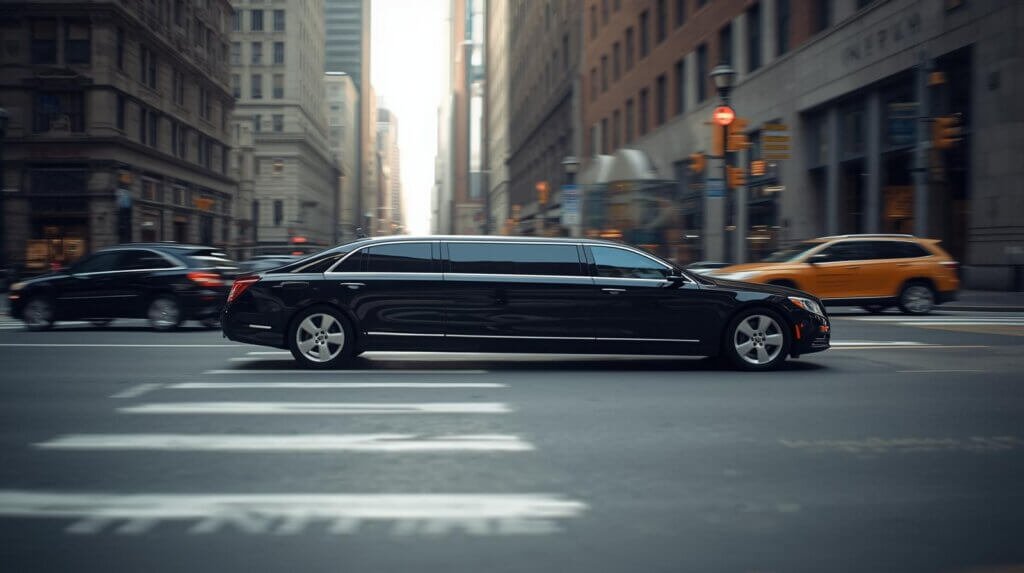
A Connecticut case in 2024 showed the risk clearly: a man posing as a licensed limo operator was arrested for defrauding passengers seeking “reliable airport rides.”
Stories like this have prompted states and the Federal Motor Carrier Safety Administration (FMCSA) to tighten oversight of limo services nationwide.
A premium limousine company in Texas expanded into Dallas–Fort Worth (DFW) airport transfers.
Everything ran smoothly, until airport security and the Ground Transportation Administration conducted an unannounced audit.
Inspectors asked for company permits, vehicle placards, and insurance proof.
Three cars lacked current permits; each was fined $500 and suspended for 30 days.
Lesson: Always keep permit records up-to-date and accessible in-vehicle.
If you market an airport limo service near me, your authorization must appear on the airport’s official permit roster.
DFW explicitly requires a company, driver, and vehicle permit for all commercial pickups.
Every major airport now enforces its own digital permit platform:
| Airport | Oversight Body | Core Requirements |
|---|---|---|
| LAX | Los Angeles World Airports (LAWA) | Company registration + vehicle tag + geofencing data sharing |
| JFK / EWR / LGA | Port Authority of NY & NJ | Pre-arranged only; no soliciting; zone access via digital ID |
| MIA | Miami-Dade Aviation Dept. | Monthly fees + ADA proof + insurance verification |
| DFW | Ground Transportation Administration | Individual driver badges + vehicle permits |
| SLC | Salt Lake City Dept. of Airports | Accessible-vehicle requirement + local ADA compliance audits |
Operating without a valid airport credential can trigger fines, towing, or blacklisting.
Above the airport level, the FMCSA sets safety baselines for all passenger carriers:
Failure to comply can void insurance or invite federal penalties.
A tech-backed black-car startup tried picking up passengers directly at LAX terminals without LAWA authorization.
Airport enforcement ticketed and expelled its vehicles.
The company sued, arguing “public access,” but the court ruled that only permitted ground-transport providers may stage on airport property.
Lesson: “Open” ride apps aren’t exempt from airport law.
If you’re offering limo service near me, make sure every airport you target lists you as an approved provider.
LAWA’s Ground Transportation Permit Program licenses over 2,500 firms, each with unique staging, fee, and data-reporting rules.
Every airport limo service must comply with the Americans with Disabilities Act (ADA) and DOT regulations (49 CFR Part 37).
Key requirements:
Ignoring these obligations can lead to civil complaints or permit suspension.
For modern brands, ADA compliance is both a legal and marketing advantage.
A shuttle company serving Orlando airports pushed drivers into double shifts to meet tourist demand.
One driver fell asleep at the wheel after 14 hours on duty, causing injuries.
The lawsuit revealed systemic breaches of FMCSA hours-of-service rules.
The court found the company negligent and awarded damages.
Takeaway: Even if your fleet focuses on short airport runs, driver logs must match federal limits. Fatigue is not a defense, it’s a violation.
| Issue | Example Impact | Legal Basis / Authority |
|---|---|---|
| Unpermitted Operation | Vehicle towed at DFW / fines at EWR | Airport authority permit rules |
| Insurance Denial | Accident while off-permit => claim rejected | FMCSA Insurance Standards |
| Driver Fatigue | Florida case – injury lawsuit | 49 CFR § 395.5 |
| ADA Violation | Passenger denied service sues | DOT Civil Rights Regulations |
| Solicitation Ban | Limo driver offering unsolicited rides in terminal | Port Authority Rule § 122.6 |
Non-compliance costs go beyond fines, they destroy trust with airports and travel partners.
Airports and operators are digitizing everything:
For a professional limo service, embracing these tools signals credibility and environmental awareness, qualities airports increasingly reward with long-term permits.
A small operator marketed “airport limo service near me” to travelers flying into Newark (EWR).
Drivers waited outside Terminal A and solicited arrivals without permits.
Port Authority officers issued tickets and towed vehicles.
When challenged in court, judges upheld the airport’s right to ban unauthorized commercial activity within its property.
Lesson: Marketing claims must match legal coverage. If you list an airport in your ads, be able to prove authorization.
Running a legal, respected limo service near me in 2025 means more than shining cars and polite drivers, it means airtight paperwork, documented safety practices, and eco-friendly foresight. The checklist below isn’t theory; it’s what airports and regulators are actually enforcing right now.
Your company must be officially registered on each airport’s authorized operator roster.
Airports like JFK, LAX, DFW, and Miami now require digital verification through QR-coded or RFID vehicle tags that link to their permit databases.
If your company name doesn’t appear in the airport’s system, your vehicle is considered unauthorized, even if you’ve served there for years.
Tip: Many airports have moved to digital permit dashboards (e.g., DFW’s GTMS Portal, LAWA’s “GT Online”). Check your listing quarterly.
Every licensed driver should carry a compliance folder containing:
Airport permit certificate or digital QR tag printout
Proof of insurance meeting minimum liability levels
Driver’s license and airport-issued ID badge
ADA compliance statement (if applicable)
Vehicle inspection log (with last inspection date signed by a mechanic)
This has become a national standard, TSA-adjacent airport police are now allowed to request these papers during random checks at more than a dozen major airports.
Driver training now goes beyond defensive driving, airports expect behavioral professionalism and awareness of anti-solicitation rules.
New York’s Port Authority (and many others) explicitly bans any direct solicitation within terminals; one verbal “Need a limo?” could cost your business thousands.
Training should also include:
New trend: Many airports now score operators on customer-service metrics. High scores can reduce permit fees or unlock premium curb access.
Digital logging has replaced paper for most fleets.
The FMCSA’s Electronic Logging Device (ELD) mandate now applies to interstate passenger carriers, and several states are expanding that to intrastate airport fleets.
Keep a daily digital record of:
Airports like Seattle-Tacoma and Denver require operators to upload monthly ELD summaries through their operator portals.
In 2025, several airports raised insurance minimums for commercial passenger carriers.
| Airport | Minimum Liability Coverage (per vehicle) |
|---|---|
| LAX | $1.5 million (minimum) |
| DFW | $1 million + additional insured endorsement |
| EWR / JFK | $1.5 million with Port Authority listed as certificate holder |
Failing to maintain or update your proof of coverage can automatically suspend your permit in most airports’ systems.
If you advertise “airport limo service near me” online, regulators expect that to be accurate.
Airports are now cross-checking Google Business Profiles, Yelp listings, and Facebook pages against their permit registries.
Misrepresentation (“serving JFK” without a valid permit) is treated as deceptive marketing. Keep your website updated to list only the airports you’re legally cleared for.
Sustainability is no longer optional, it’s part of the permit renewal conversation.
Airports in California, Washington, and Massachusetts have introduced “green-fleet credits.”
At LAX and SFO, zero-emission vehicles (ZEVs) are expected to comprise at least 50 % of permitted fleets by 2027.
Investing in hybrid or fully electric limousines not only lowers fuel costs but may soon determine whether you get a renewal.
Subscribe to:
Rules are changing quarterly, staying informed protects your brand long before a fine hits.
Bottom line: Compliance is the new marketing.
Consistency builds trust, and trust is what converts every Google search for “limo services near me” into a loyal passenger booking.
Ground transportation is evolving as quickly as the skies above it.
Here’s what’s on the immediate horizon for airport limo services heading into 2026:
The Department of Transportation is piloting a National Ground-Transport Registry, linking airport permit systems under one umbrella.
Within a year, a suspended permit at LAX could automatically flag you at DFW or MIA.
Translation: No more “I didn’t know.” Compliance in one airport will soon depend on your record in another.
AI is entering the chauffeur world.
Airports and insurers are analyzing driver telemetry, braking patterns, speed variance, fatigue prediction, to calculate a Safety Integrity Score for each fleet.
High scores can unlock lower insurance premiums and better curb access slots.
Low scores may restrict your vehicle to less desirable pickup zones.
Airlines like Delta and United are experimenting with integrated booking options: book your flight + car service in one app.
Only vetted airport limo service providers with clean permit records will be eligible.
This integration could redefine lead generation for compliant limo companies.
Pilot programs are already live in Phoenix Sky Harbor and Las Vegas McCarran airports.
While driverless tech won’t replace chauffeurs overnight, it will push regulators to update safety certification frameworks, and may lead to dual-operator lanes where autonomous vehicles and limos share zones.
Starting 2025, airports like SFO, SEA, and BOS require operators to log fuel type and mileage to compute emissions.
In 2026, that data may directly influence permit renewals.
Green fleets will get priority access, while high-emission vehicles could pay congestion surcharges.
Insider takeaway: Operators who modernize early, with EVs, digital logs, and AI-assisted safety, won’t just comply; they’ll dominate search visibility and customer confidence.
To them, a licensed airport limo service offers something far more valuable than luxury, certainty.
Here’s what today’s travelers expect when they tap “limo service near me” on their phones:
Why it matters: Trust is becoming the currency of travel.
Travelers increasingly cross-check Google reviews with airport permit lists before booking.
That’s how compliant limo services win repeat business, not through ads, but through verified credibility.
By 2026, the line between air and ground travel will blur completely.
Expect a federal-state unified platform that syncs operator licenses, insurance data, and EV metrics in real time.
The most successful limo service won’t necessarily have the largest fleet, it’ll have:
Government policy is also shifting toward “Safety by Design.”
That means compliance will be automated, if your vehicle’s telematics detect irregular driving, the system could auto-flag your permit.
It’s accountability built right into the dashboard.
Key insight: In this new ecosystem, credibility > capacity.
Invest in transparency now, and you’ll secure airport access long after paper permits disappear.
Airport transportation in 2025 isn’t just about being first at the curb; it’s about being right at the curb.
Luxury without legality is just risk on wheels.
When passengers search “airport limo service near me,” they’re not just chasing comfort, they’re looking for assurance:
that the driver is vetted, the car is insured, and the company won’t vanish after payment.
So the next time your phone buzzes with a new booking, remember what really drives this business:
Permits prove professionalism
Training earns trust
Transparency builds loyalty
In a world of AI dashboards, green mandates, and zero-tolerance enforcement, the smartest limo services aren’t merely adapting, they’re setting the standard for safe, sustainable, and trustworthy airport travel.
By Book N Ride
Connecticut & New York Airport Limo Service Experts
Dedicated to providing licensed, insured, and verified transportation for travelers who value comfort, safety, and trust.
📌 Also Read: how to start a limo business NYC


Easy pickup, on time even with my late request, emails answered promptly, and all-around highly professional experience. You will hear from me again!

Erik
Driver was fantastic, best driver I have ever had. A pleasure to drive with.
Maria